Leadership Workshop

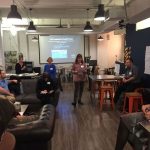
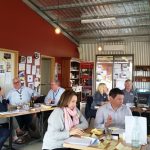
Due to the success of the IMPACT workshop held in October 2011, Anne Hartican of Bespoke Results and I are facilitating another workshop on March 20.Again it is being held at Melbourne’s boutique conference centre Airlie ( see image left) .

The workshop is a wonderful opportunity to further explore your leadership capabilities in depth.

The workshop is highly experiential and uses action learning, reflection and simulation to assist with your learning.

A follow up coaching session is offered as part of the package. The total package including catering is $600 inc GST

Electronic registrations are now open. To access the brochure on which there is a link to register please click on IMPACT workshop

Posted in leadership, workshop | Tagged , , , , , | Comments Off

KM Asia

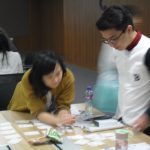
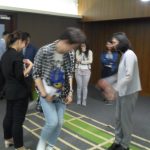
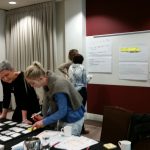
Recently at KM Asia in Singapore I co facilitated a workshop with Arthur Shelley from Intelligent Answers. We aimed at facilitating the workshop so the participants could develop an understanding of the use of metaphor through the Organizational Zoo (see Organizational Zoo in blog roll) cards and how this metaphor can contribute to developing an understanding of and working with a variety of behaviors in a team and collaborative context.

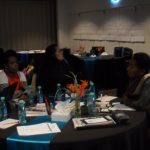
The group was a highly multicultural group with people from Malaysia, Chinese mainland, Egypt, Singapore and India. The workshop was structured around developing an understanding in the first instance of the use of metaphor. This was achieved by introducing the participants to some of the animal characters in the zoo so they could talk about what came to mind, when, for example they saw the picture of the lion. This developed a common understanding of the concept and a sense of confidence and safety in using the concept of metaphor to understand behaviors.

We then built teams using the notion of animal metaphor and which set of behaviors and characteristics would contribute positively and then negatively to a team. Rich conversation evolved out of this exercise and it became clear to people that the issue of behavior was contextual.

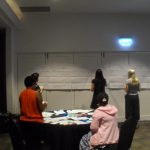
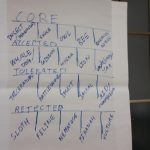
Participants then worked in small groups, designing their own scenario to apply the techniques . They were asked to look at behaviors in this instance that were  highly desirable , good to have , tolerated and not desirable. Some of the scenarios chosen were ” Being a Parent” and “Giving a  Performance Review” The outcomes of the exercise generated a great deal of conversation, debate and knowledge sharing which would not have occurred as easily without the metaphors. It also developed a sense of collaborative activity and dialogue amongst the group and a respect of the notion that there are many differences in how we do things.

Comments made by the participants were very positive:

“Very informative, fun and interactive. I can apply what I learnt in may situations. I am eager to use it.”

“Interesting way of understanding behaviors in organizations. Effective and impactful way to stimulate collaborative practices for enhanced performance. These methods of facilitation/teaching have a lasting impact. than the traditional methods. A perfect way to learn through fun.”

The workshop has introduced me to interesting technique in profiling behavior. I can definitely see many usage techniques in the following scenarios- team building, hiring/staffing, adapting different behaviors during project lifestyles”

Posted in Conversations, organisational culture, workshop | Tagged , , | Leave a comment

Narrative Research

Recently I was discussing the issue of narrative research at the KM Asia Conference in Singapore. Some years ago I was engaged in using the technique, albeit in a very raw form when I was evaluating a program I was managing for Victoria Police.  The richness of the anecdotes and the emergence of issues were very powerful and provided a clear hook for people’s understanding of what we were doing.

In a later role a similar technique was used in evaluating the ROI on a senior leadership program. The whole issue of looking at ROI for such a program caused a great deal of thinking and struggling with what might be the best way to do it as one cannot simply turn out leadership widgets at the conclusion of the program. In this instance I used a technique more aligned with the work undertaken by Brinkenhoff but in a modified format. This again proved to be useful and captured the richness of experience as well as the impact for people. It was also a method by which we could continue to capture the impact over time and develop a rich knowledge repository.

In later times I have applied the methodology developed by Cognitive Ede by using Sensemaker. In this particular instance we needed an innovative method of evaluating and capturing the impact of a statewide innovation network that was funded by the Victoria Public Service. Sensemaker provided the tool that allowed us to capture narrative , make sense of the anecdotes and look at emergent trends. I have uploaded a copy for those who are interested VPSCINevaluation2

I am currently collaborating with some colleagues in developing other pieces of narrative research using Sensemaker and anecdotes. Some of this is anticipated to be quite ground breaking and I hope that I am able to share details on this blog in the not too distant future.

Posted in emergence, leadership, narrative research | Tagged , , , | Leave a comment

Organisational Values and Behaviours

I recently facilitated a workshop for a client who was grappling with the issue of organisational values. In initial discussions we agreed that the values were meaningless if just posted on the wall as words.  What one word means to one person means an entirely different thing to another. What emerged as important was the underlying behaviours that either supported or detracted from the espoused value.

The other complicating issue was that the values as yet had not been agreed. This was  symptomatic of how various sections of the organisation saw their identity as even though they were all the one organisation, their employment conditions and who they were employed by were completely different as were the jobs they undertook.

So a decision was taken to work with the underlying behaviours in the form of narrative and metaphor. The Organizational Zoo techniques developed by Arthur Shelley were the tools of choice for the metaphor.

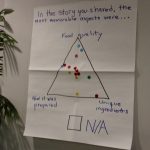
Participants were encouraged to share stories in response to stimuli and then choose a positive story to which they applied the Organizational Zoo metaphor. Through the use of the animal cards they were able to identify positively contributing behaviours and behaviours that detracted from the story. As a whole group they then designed their own Organizational Zoo.

This brought about a number of benefits and quite exciting results. One was the open and rigorous conversation that took place about appropriate behaviours and the group decision that was reached about what was ok or not. Secondly there was emergent use of other metaphor to talk about situations. For example they wanted to use the instruction cards in the box of cards as part of their Zoo as this represented the legislation on which their work was based!!! And there was also the emergence of values that the group agreed to. These were their own,with an understanding of the underpinning attendant behaviors.

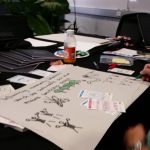
It was also fascinating to see how many drew characters as well as having the conversation. The drawings seemed to stimulate conversation and dialogue within their small groups. Below is an example of the drawing which is amazingly accurate in terms of the characters developed in the Organizational Zoo!!!

The organisation now has their own Organizational Zoo to refer to metaphorically in terms of what they want to be and are continuing the conversation to strengthen the understanding.

Posted in Conversations, emergence, organisational culture, workshop | Tagged , | 1 Comment

Leadership Workshop

IMPACT

Influencing, Mastering Power, Authority, Control, Tactics

a professional development opportunity

Registrations are now open electronically for the IMPACT workshop on October 25.

The workshop is being facilitated  jointly by Bespoke Results and Creative Cognicion.

It is a wonderful opportunity to further explore your leadership capabilities in depth.

The workshop is highly experiential and uses action learning, reflection and simulation to assist with your learning.

A follow up coaching session is offered as part of the package,

To register, please click on the link bespoke_brochure_6_Aug_2011 which

takes you to the brochure and then click on “here” on the brochure which will take you to the registration page.

Posted in leadership, workshop | Tagged , , | Leave a comment

Thinking More About Leadership

Recent events in an organisation I am only too familiar with have again set me thinking about leadership and the need to develop leaders who are empathic, emotionally intelligent and who recognise the worth and importance of the people within the organisation. Life is complex, work is complex and we need leaders who are able to recognise that and to empower the people in the organsiation to make choices, experiment with different ways  of doing things and to develop mastery and a sense of intrinsic self fulfillment. Not an easy task and traditional ( whatever they might be!!!) and remote leaders in this day and age simply do not cut the mustard.

As a result of my thinking I remembered an article by Robert Goffee that I circulated widely when I worked in that particular organisation. It brought  response….both positive and negative and at least started the conversation about leadership!!! The article is here why should anyone be led by you. Maybe it will start a conversation in your organisation too!!!!

Posted in leadership | Tagged , | Leave a comment

Leadership Workshop

IMPACT

Influencing, Mastering Power, Authority, Control, Tactics

a professional development opportunity

We live in complex and demanding times, and demands for leaders in organisations  to be skilled and respond have never been greater.

Organisations are complex social and political systems. Optimising their performance requires a sophisticated set of skills to effectively manage the emotional and social processes that impact on group and organisational performance.

Creative Cognicion in collaboration with Bespoke Results are faclitating a workshop on October 25.

In this highly experiential workshop you will be provided with deep insights into what makes organisations and groups tick.  We will examine the cultural and systemic factors that either support or have the potential to derail your organisation’s ability to deliver on its strategic objectives.

Registration is currently open and further details including registration details can be obtained by contacting Laurel on laurel.sutton@cre-ativ-cognicion.com.au.

Electronic registration will  be available in the first week of August.

Posted in leadership, workshop | Tagged , , | Leave a comment

3 New Workshops

Creative Cognition is offering 3 new workshops.

Influencing

Are you often confronted with “No” as the first answer to your ideas? The Influencing workshops can assist you in having “Yes” said more often. The workshops use metaphor drawing on Organizational Zoo techniques to understand behaviors, and a range of creative techniques to help you develop your pitch. The workshops are a series of half day workshops with workplace application between sessions to help gain traction for the capabilities learnt. A less intensive whole day workshop is also offered.

Improving Your Team

Through the use of metaphor and designed interactions participants can explore how to improve their team interactions and thereby build a more effective team. The workshop helps participants gain insights into their own behaviors as well as that of the team and make adjustments where necessary.  It takes participants beyond the traditional “team building approach” into the realm of behaviors and attitudes and self reflection. Organizational Zoo techniques are drawn upon to develop the metaphors and understand behaviors in a fun and safe manner.

How to Move Forward (& not be frozen by risk!!)

This half day workshop assists with making risk an enabler rather than a barrier to moving forward. It looks at risk head on rather than denying it and helps the individual or group use it to their advantage. It is conducted in collaboration with “Think Quick”

A description of all offerings can be found in workshops creative cognicionjune 2011

Posted in workshop | Tagged , , | Leave a comment

“No You Can’t Do That”

Recently I have been coming across people who are finding the whole notion of getting their ideas knocked back really frustrating. The RMIT students I mentor were talking about it,  people who are in big organisations are describing it to me and individuals who are simply trying to make a difference are also experiencing it. I do not think the ” No you can’t do that” syndrome is on the increase, but it does seem to be an emerging pattern in the conversations I am having.

It set me thinking about ways to deal with and manage the situation.

The first that came to mind was de Bono 6 Hats application.  By structuring a meeting or a conversation using 6 Hats the thinking can focus on the positive first and then the risks, rather than the other way around. It may go something like this:

Blue Hat   “We are going to look at such and such an idea and make a decision about its implementation”

White Hat ” This is the idea

Yellow Hat “These are the benefits of the idea”

Black Hat ” These are the risks of the idea”

Red Hat (briefly) ” This is what we feel about the idea” 

Blue Hat “This is what we are going to do about the idea”

This keeps people focused and balanced, and puts the positive before the negative instead of the usual human trait of defaulting to the negative  first all the time.

Alternatively one of the DATT tools such as Plus Minus Interesting could be used instead.

Another way would be to work with the group generating the ideas is to undertake an archetype extraction. I did such a thing when working within the Victoria Public Service and we looked at innovation within the public service.  The archetypes were the product of a cross sectional group from the public service and provided ways of  identifying  and understanding the behaviours of innovation blockers. Therefore ways of managing the behaviour could be found.  Archetypes include characteristics and attributes and are none of us but many of us.

A third approach is that of metaphor. Arthur Shelley’s Organizational Zoo character cards are wonderful for metaphor. The cards are representative of animals in the Zoo ( organization) Each has particular behaviours and attributes  and all are neither good nor bad. This is the perfect opportunity to look at behaviours in the third person and remove the discussion about the blockers from the personal. Conversation around the animal metaphors can then lead to how do we solve the problem of not getting uptake of our idea. 

So all is  not lost when someone says ” No You Can’t Do That”

For further information or assistance with exploring the implementation of any of the above please contact  laurel.sutton@cre-ativ-cognicion.com.au


Posted in organisational culture | Tagged , , | Leave a comment

Organisational Culture


Last week I attended  a webinar that got me thinking. The focus of the webinar was organisational culture and the relationship of Unwritten Ground Rules (UGRs) and the locus of control.

UGRs according to Steve Simpson are “the way we do things around here” They are frequently unspoken and unconscious and more form habits which in turn influence the behaviours of individual in organisations.  As an extension of this I went on to  think about how they formed part of the psychological contract between people in the workplace.  That contract is often not overted either and when breached causes angst, feelings of being let down etc. So if UGRs are habits that influence people’s behaviours then they are most likely patterns of thinking and understanding which manifest themselves as behaviours.

Linked with the notion of UGRs is the locus of control of individuals. Now we do not mean micro management but rather the extent for which people take responsibility for their own feelings, thoughts and achievements. People with a positive and high level of internal locus of control tend to foster positive  UGRs so the culture in turn becomes a positive one. People with an external locus of control ie one where everyone else and events are responsible for what happens tend to foster negative  culture and negative UGRs ie ones of blame and lack of responsibility.

So the question remains is how to change organisational culture? A complex issue and belongs in the complex domain.  I would suggest that rather than tackling organisational culture per se and with usual linear responses, that multiple probes experiments are conducted to disrupt people’s thinking patterns. We do not know exactly what will work but the use of De bono thinking tools and some of the Cognitive Edge techniques would be a good place to start. This then has the potential to disrupt and change  habits and therefore behaviours and therefore the negative UGRs. And those that create the most disruption we continue with and those which have no effect we discontinue!!!

And finally when discussing this with a friend who I suggested had a high internal locus of control, their response was  I feel I am a pelagic soul in life’s currents awaiting the plankton of experience to nurture my needs”. High internal locus of control or not??????

Posted in organisational culture | Tagged , , , | Leave a comment